Meta Ads for local businesses: when it makes sense
On Google people search for you; on Instagram you interrupt them. Which local businesses fit Meta Ads, which do not, and what to have ready.
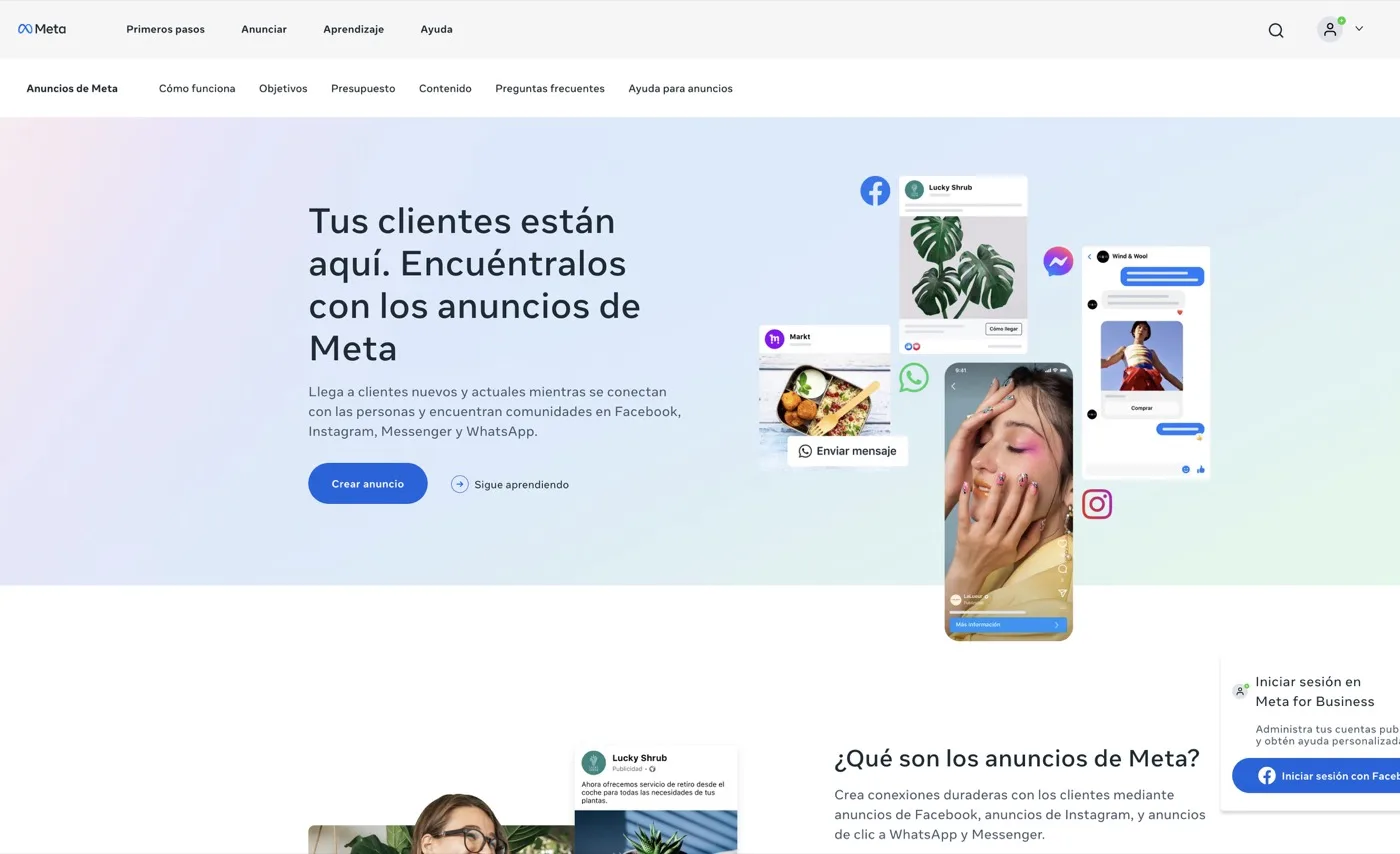
Advertising on Instagram and Facebook is easy to start and easy to get wrong. The “boost post” button is one tap away, which is why many local businesses spend months without knowing whether it did anything for them. The right question is not how much to invest, but whether your business fits that shop window. And that is decided by understanding one difference that explains almost everything.
The difference that explains everything: searched for, or stumbled upon
On Google, people are already searching for what you sell. Someone types “dentist in Madrid” because they have a need, they have put it into words and they are deciding now. The demand already exists: your job is to appear when it shows up. The ad does not create the want, it puts itself in front of it.
On Instagram and Facebook, you interrupt someone who was not looking for you. That person is passing the time, looking at photos of people they know and videos, and your ad slips in between. Three seconds ago they had no intention of buying anything from you. The demand does not yet exist: it has to be woken up.
Everything else hangs off that. On Google you compete to capture an intention that has already formed; on Meta you compete to create an intention that was not there. They are two different jobs, with two different kinds of ad and two different ways of knowing whether they worked.
This has an immediate practical consequence: a Meta ad that just states what you sell usually fails. On Google that is enough, because the user already wanted it. On Instagram, if there is nothing to stop the thumb — an image that appeals, a clear offer, something that wakes a desire that was not there — the ad scrolls past with the rest of the screen.
Which local businesses fit well
The ones whose purchase is visual, appealing and quick to decide. If your product is understood by looking at it and can be bought on impulse, the interruption works in your favour.
Food and drink. A well-photographed dish, a terrace, a new menu. Nobody was looking for somewhere to have dinner at six in the afternoon, but seeing the right photo makes them think about it.
Beauty, hairdressing, nails, tattoos. The clearest case, because the result of the service is the image. Before and after convinces without argument.
Shops with visual products. Clothing, homeware, florists, jewellery. The shop window works the same on the street and on the screen.
Events and dated activities. Concerts, workshops, open days, markets, booking seasons. Here Meta does something Google cannot: tell people who did not know the event existed.
Newly opened businesses. When nobody searches for you by name because nobody knows it, interrupting is the only way into the conversation.
Which local businesses fit badly
Services that get hired when the problem arises, and not before. Here the interruption wakes nothing, because there is nothing to wake.
Emergencies. Locksmith, emergency plumber, tow truck, appliance repair. Nobody sees a locksmith ad over dinner and thinks “great, I’ll make a note”. When that person needs you they will pick up their phone and search, and the place you need to be is Google and the map, not their feed.
One-off search services. A lawyer for a specific matter, a surveyor, a tax adviser at filing season. The need is born from a concrete event and is resolved by searching.
Long, considered decisions. When weeks of comparing and asking around pass between seeing the ad and hiring, the interruption dilutes. It can help people get to know you, but expecting direct sales is expecting what will not happen.
Businesses with nothing visual to show. If your service cannot be photographed or explained in a short, attractive video, you are competing on ground that is not yours.
This is not a condemnation: a locksmith can use Meta to become known in their neighbourhood. But if they only have resources for one thing, that thing is not Meta.
What to have ready before spending the first euro
Two things. Without them, the spend is a donation.
Where the click lands
The person clicking your ad is one finger-movement away from leaving. What they find on landing decides whether that click was worth anything.
You need a page that continues exactly what the ad promised: if you advertised the set lunch, that is where they land. It must load fast on mobile, because that is where the person is, on a street connection. The action must be visible without searching: call, book, message on WhatsApp, get directions. And it must be obvious at a glance where you are, because you are a local business and that is the first question of anyone seeing you for the first time.
How you will know whether it worked
Before switching anything on, answer this: what has to happen for you to say it worked? A booking, a call, a message, a visit to the shop. Write it down before starting, because afterwards it is very easy to settle for the likes.
And decide how you will check it. What happens on the website is measured with the tools installed on it. What happens outside — whoever walks through the door — is measured by hand, and asking is enough: “how did you hear about us?”. It is low technology and it works.
Without this part there is no campaign, there is spending with hope attached.
Typical mistakes we see over and over
An audience that is too broad. It is the number one mistake of local businesses. If your customers live fifteen minutes from your door, showing the ad to half the region is paying to show it to people who will never come. Narrow it to the area customers actually come from and to interests consistent with what you sell. A small, well-chosen audience performs better than an enormous one.
Creative that looks like a bank advert. Immaculate stock photo, smiling people who are not your team, and an empty slogan. On Instagram that language is identified as advertising instantly and scrolled past. What works for a local business is the opposite: your premises, your real product, video shot on a phone, the face of the person who serves. Looking like what you are is an advantage over the big brands, not a limitation.
Sending all traffic to the home page. The ad talks about one specific treatment and the click lands on the front page, with ten services, a carousel and a welcome message. The person has to go looking again for the thing that interested them, and they do not: they leave. Every ad to its own page.
Confusing engagement with business. Likes and followers do not pay invoices. If the campaign is judged by them, you will end up optimising to be liked instead of to sell.
The honest part: for many local businesses, the Google profile pays off more
Here is where we say something against our own commercial interest: if your business is local and you can only work on one thing, it is almost always the Google Business profile, not Meta ads.
The reason goes back to the difference at the start. The Google profile puts you in front of people already searching for what you sell, in your area, when they need it. It appears on the map, shows your photos, your opening hours, your reviews and the call button. It does not switch off when you stop paying, because there is nothing to pay. And for a business on a high street, that existing demand is usually greater than the owner imagines.
Meta ads, by contrast, are work in waking up interest: more demanding creatively, with an effect that disappears the moment you stop.
So the order we recommend to a local business is: first the Google profile properly worked and the reviews up to date; then, if the business is one of the visual ones, Meta ads as an amplifier. How to work on that profile we explain step by step in how to appear on Google Maps.
If you are torn between putting the money into ads or into search optimisation, we go into that comparison in Google Ads or SEO.
The next step
Meta Ads makes sense for a local business when three things are true at once: what you sell appeals to the eye, the buying decision is quick, and you have something real to show. If any of them is missing, there is earlier work that will pay off more.
Knowing which of the two groups you are in does not require guessing: it shows by looking at your business, your profile, your website and what already happens when people search for you. That is what we do in the free, no-obligation audit at Ryojin.TECH: where the effort should go first and what is holding you back today. With written conclusions, whether you work with us afterwards or not.
Request your free audit and avoid spending on the wrong shop window.